Non-Surgical Nose Job with Fillers – Treatment, Benefits and Expected Results
The nose plays an important role in facial balance, and even small irregularities can affect its overall appearance. While surgical rhinoplasty offers permanent structural changes, not everyone wants surgery or a lengthy recovery period.
A non-surgical nose job, also known as liquid rhinoplasty, uses dermal fillers to improve selected nasal contours without surgical incisions. It may help camouflage minor bumps or asymmetry, offering subtle changes with relatively little downtime. However, the procedure has limitations and carries rare but serious risks.
What is Non-Surgical Rhinoplasty?
Non-surgical rhinoplasty is a cosmetic procedure that uses injectable dermal fillers to adjust the visible shape of the nose. Hyaluronic acid fillers are commonly used because they provide volume and can sometimes be dissolved when clinically appropriate.
Unlike surgical rhinoplasty, which can reshape nasal bones and cartilage, nose filler treatment works by adding volume to carefully selected areas. For example, filler may camouflage a small bump along the nasal bridge, creating the appearance of a straighter profile.
However, fillers cannot physically reduce nasal size. Since they add volume, the nose may become slightly larger in certain areas even when its overall appearance looks more balanced.
How nose fillers change facial appearance

The appearance of the nose depends on its underlying structure, skin thickness, proportions, and relationship with surrounding facial features.
During a non-surgical nose job, a qualified medical practitioner may place filler in selected areas to improve the appearance of minor contour irregularities. Small adjustments along the nasal bridge can influence how light and shadow fall across the nose, creating a smoother-looking profile.
Some patients may notice improved bridge definition or reduced visibility of mild asymmetry. However, fillers cannot reliably correct major structural deviations, significantly reshape the nasal tip, or improve breathing problems caused by internal nasal anatomy.
Cosmetic concerns addressed by Liquid Rhinoplasty
Liquid rhinoplasty is generally considered for minor cosmetic concerns rather than significant structural changes.
Common concerns that may be suitable for treatment include:
- Small nasal bumps: Fillers may camouflage minor irregularities along the nasal bridge.
- Mild nasal asymmetry: Carefully placed filler can make selected uneven areas appear more balanced.
- Low nasal bridge: Fillers may add definition and improve the appearance of bridge height.
- Minor contour irregularities: Small depressions or uneven areas may be improved in suitable patients.
- Selected post-rhinoplasty irregularities: Fillers may sometimes address minor residual concerns, although previously operated noses require additional caution.
Not every patient is suitable for nose fillers. A detailed consultation is essential to assess facial anatomy, treatment expectations, and potential risks.
Non-Surgical nose job procedure
A non-surgical nose job begins with a consultation to assess nasal anatomy, medical history, previous cosmetic treatments, and desired results.
The procedure generally involves the following steps:
- Facial assessment: The practitioner examines the nasal bridge, tip, symmetry, and skin thickness.
- Treatment planning: Suitable injection areas are identified according to the patient’s anatomy.
- Skin preparation: The treatment area is cleaned before the injections.
- Filler administration: Hyaluronic acid filler is carefully injected into selected areas using an appropriate technique.
- Result assessment: The practitioner evaluates the initial contour changes and provides aftercare instructions.
The injection process may take approximately 15–30 minutes, although the complete appointment can be longer.
Some patients experience mild pressure, pinching, or discomfort during treatment. Initial results are often visible immediately, but swelling may temporarily affect the appearance.
Non-Surgical nose job before and after results
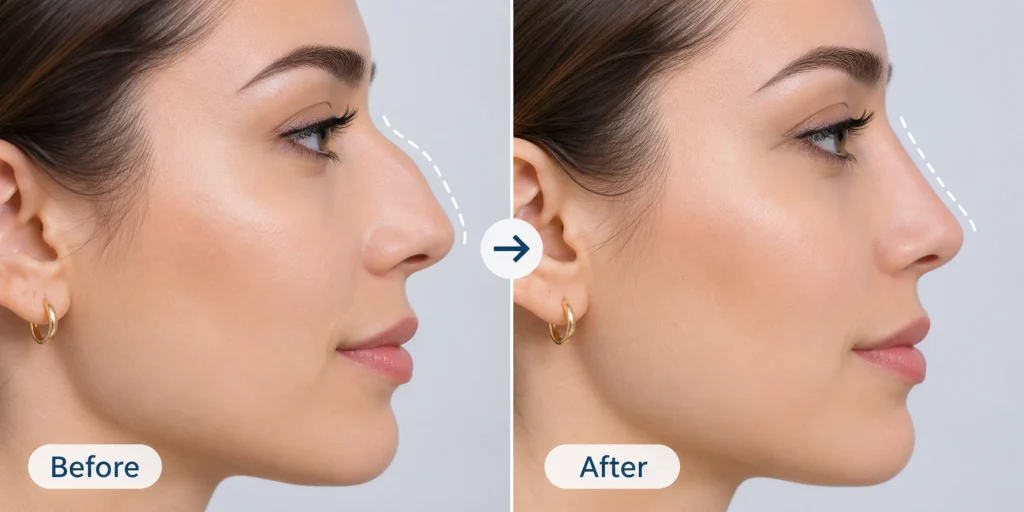
Non-surgical nose job before-and-after results generally involve subtle improvements in nasal contour rather than major changes in size or structure.
Patients with a small dorsal hump may notice that the nasal bridge appears straighter from the side. Others may experience a more balanced-looking profile or reduced visibility of minor irregularities.
However, a nose that looks straighter from the side may not appear narrower from the front. Fillers cannot remove a prominent hump, reduce a wide nasal base, or correct a significantly deviated septum.
Results vary according to individual anatomy, filler placement, and treatment goals. Before-and-after photographs should also be assessed carefully because lighting, camera angles, and temporary swelling can influence the appearance.
Benefits and limitations of nose filler treatment
One of the main reasons patients consider non-surgical rhinoplasty is the possibility of improving minor nasal contours without undergoing surgery.
The procedure does not usually require general anaesthesia or surgical incisions, and many patients can return to routine activities relatively quickly.
Hyaluronic acid fillers are also temporary, allowing the visible result to change over time. However, temporary does not mean completely reversible or risk-free. Filler may remain in the tissues longer than expected, and dissolving it cannot guarantee reversal of every complication.
Non-surgical rhinoplasty is best suited to selected cosmetic adjustments. Patients seeking significant nose reduction, major reshaping, or functional improvements may benefit more from a surgical consultation.
Duration of nose filler results
The duration of nose filler results depends on the filler used, injection location, individual metabolism, and other factors.
Some patients notice cosmetic results lasting approximately 9–18 months, while others experience shorter or longer persistence.
Hyaluronic acid fillers gradually change over time, but the material may remain in the tissues beyond the period when its visible effect is noticeable.
Repeat treatment should be considered only after professional assessment. Excessive or repeated filler placement can affect nasal appearance and increase the risk of complications.
Safety considerations and potential complications
The nose is considered a high-risk area for dermal filler injections because its blood vessels connect with circulation around the eyes.
If filler enters or blocks a blood vessel, it can interrupt blood flow and cause serious tissue damage.
Potential complications include:
- Swelling and bruising: Common temporary reactions around injection sites.
- Infection: Possible when appropriate sterile procedures are not followed.
- Skin necrosis: Tissue damage caused by interrupted blood circulation.
- Permanent scarring: May occur following severe vascular complications.
- Vision loss or blindness: Rare but serious complications associated with vascular blockage.
- Stroke: An extremely rare but potentially life-threatening complication.
Although hyaluronic acid fillers may sometimes be dissolved using hyaluronidase, this does not guarantee recovery from vascular injury or restoration of vision.
For this reason, nose filler treatment should only be performed by an appropriately qualified medical practitioner with detailed knowledge of facial anatomy and emergency management.
Recovery and aftercare following nose fillers
Most patients experience relatively little downtime following a non-surgical nose job. Mild redness, swelling, bruising, and tenderness may occur around the injection sites and often improve over the following days.
Practitioners may recommend temporarily avoiding unnecessary pressure on the nose, strenuous exercise, and certain facial treatments.
Following the treating clinician’s aftercare instructions is essential.
Severe or increasing pain, unusual skin discolouration, or mottled skin requires immediate medical assessment. Any sudden change in vision following nose filler treatment is a medical emergency.
Non-Surgical Rhinoplasty and surgical nose reshaping
Non-surgical rhinoplasty and surgical rhinoplasty are designed to address different concerns.
Nose fillers may be suitable for individuals who want to camouflage small contour irregularities without permanently altering nasal structures.
Surgical rhinoplasty, on the other hand, can reshape nasal bones and cartilage, reduce nasal size, correct certain structural concerns, and sometimes improve breathing when appropriate functional procedures are performed.
Surgery involves a longer recovery period and carries its own risks, including infection, anaesthetic complications, and healing problems.
The most appropriate option depends on the patient’s anatomy, cosmetic goals, medical history, and willingness to accept the associated risks.
Choosing the right practitioner for nose fillers
The safety and results of a non-surgical nose job depend on the practitioner’s expertise. A qualified professional should assess nasal anatomy, explain potential risks, and recommend treatment only when appropriate.
Nose fillers can improve minor bumps, asymmetry, and contour irregularities without surgery. However, they cannot reduce nasal size or correct major structural concerns, making professional assessment essential.
If you’re considering nose filler treatment, our aesthetic team at Revival Clinics can help assess your facial anatomy, explain the available options, and determine whether non-surgical rhinoplasty is suitable for you. Contact us at +971 4 566 3377 to book a consultation and explore your options for natural-looking nasal enhancement.