
If you’re thinking about laser hair removal, one of the first questions you’re likely to ask is “How many sessions will I need?” For many people, around 6–8 laser hair removal sessions may be recommended as an initial course. However, there isn’t a fixed number that works for everyone.
Your treatment area, hair colour and thickness, skin tone, hormonal influences, laser technology and individual response can all affect the number of treatments you need. So why can't all the unwanted hair be treated in one or two appointments? The answer mainly comes down to the way your hair grows.
Why do you need multiple laser hair removal sessions?
Your hairs aren't all growing at the same time. Each individual hair moves through different stages of a hair-growth cycle.
There are three main stages:
- Anagen – Active growth: The hair is actively growing. Laser hair removal is generally most effective during this stage.
- Catagen – Transitional stage: The hair stops actively growing and begins transitioning away from its growth phase.
- Telogen – Resting stage: The follicle rests before the hair eventually sheds and a new growth cycle begins.
At any given time, only a proportion of the hairs in a treatment area will be in the ideal stage for laser treatment.
This means a single session can't effectively target every hair. When you return for additional sessions, more hairs will have moved into their active growth stage and can then be treated.
That's why laser hair removal is planned as a course of treatments rather than a one-time appointment.
Are 6–8 laser hair removal sessions enough?
For many people, 6–8 sessions can be a useful starting estimate, but it shouldn't be viewed as a guaranteed number.
You may see a noticeable reduction during your initial treatment course but still require additional sessions.
The number you ultimately need can depend on:
- Treatment area
- Hair colour
- Hair thickness
- Hair density
- Skin tone
- Hormonal factors
- Laser technology
- Treatment settings
- Previous hair-removal methods
- Individual response
Rather than concentrating only on completing six or eight appointments, it's more useful to look at how your hair is responding throughout the treatment course. Your practitioner can assess your progress and recommend whether additional sessions are appropriate.
Why do some people need more than 8 laser hair removal sessions?
Needing more than eight sessions doesn't necessarily mean laser hair removal hasn't worked.
There are several reasons why someone may require additional treatments.
Hormonal influences can stimulate new facial or body hair growth, potentially increasing the number of sessions required.
Hair characteristics also matter. Fine or lightly pigmented hairs can be more difficult for the laser to target than coarse, darker hairs.
Your treatment area can also affect your response because hair-growth cycles vary across different parts of the body.
Finally, everyone responds differently. Two people treating the same area with the same number of sessions may not experience exactly the same degree of hair reduction.
Does the treatment area affect how many laser sessions you need?
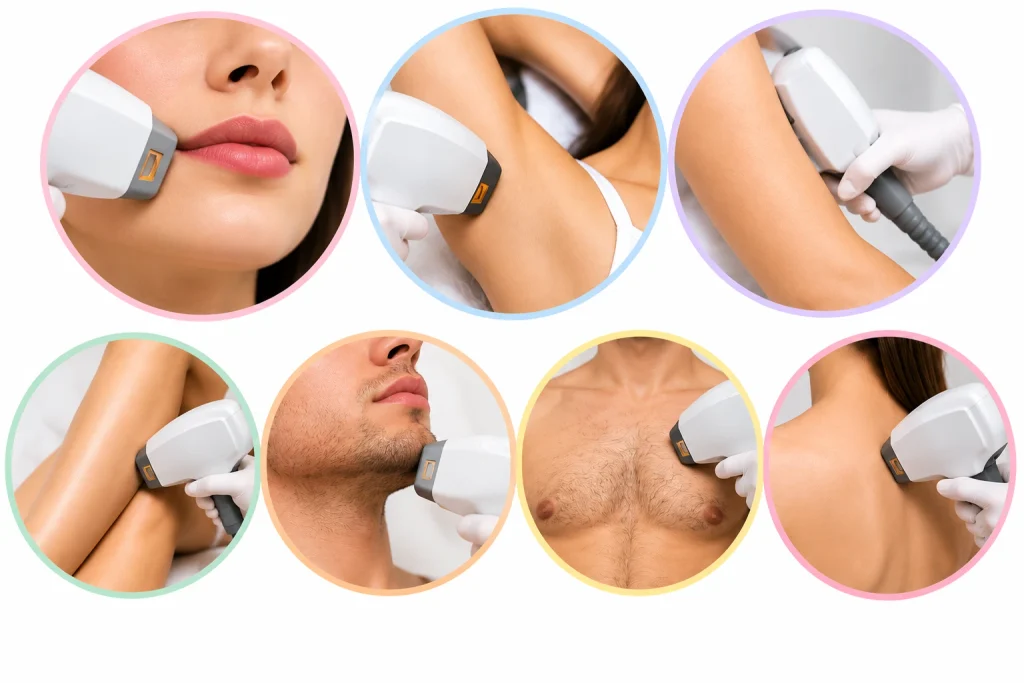
Yes. Hair doesn't behave exactly the same way across every part of your body.
Common areas treated with laser hair removal include:
- Face, upper lip and chin
- Neck
- Underarms
- Arms
- Bikini and Brazilian areas
- Legs
- Chest
- Abdomen
- Back
Hair-growth cycles can vary between these areas. Facial hair, for example, may behave differently from hair on your legs or underarms.
Some areas can also be more strongly influenced by hormones, which may affect how many sessions you need and whether maintenance treatments are required later.
This is why someone having laser hair removal on their legs may have a different treatment schedule from someone treating facial hair.
How many laser hair removal sessions do you need for different body areas?
There isn't a fixed number of laser hair removal sessions for a particular body area. While around 6–8 sessions may be used as an initial estimate, the number you actually need can vary depending on:
- Hair thickness and density
- Hair colour
- Skin tone
- Hair-growth cycle
- Hormonal influences
- Individual response to treatment
Different areas of the body also have different hair-growth patterns, so the number and timing of sessions may vary.
- Face: Facial hair can be strongly influenced by hormonal factors. If new hair growth continues, additional sessions or occasional maintenance treatments may be needed.
- Underarms: The number of sessions depends on hair thickness, density, skin tone and treatment response. Over the course of treatment, you may notice slower regrowth, reduced density and finer hairs.
- Legs: Hair-growth cycles on the legs differ from areas such as the face or underarms. Your treatment schedule will therefore depend on your individual growth pattern and response to each session.
- Bikini and Brazilian areas: Hair density, thickness, skin tone and individual response can all affect the number of sessions required. Coarser, darker hairs provide a stronger pigment target than very fine or lightly pigmented hairs.
Rather than expecting a particular number of sessions for each body area, your progress should be assessed throughout the course.
How often should you have laser hair removal and what can you expect?
Laser hair removal sessions are generally spaced several weeks apart, depending on the treatment area, hair-growth cycle and your response. Having sessions too close together may offer little additional benefit if enough new hairs haven't entered the appropriate growth stage.
After the first few sessions, you may notice:
- Slower hair regrowth
- Reduced hair density
- Finer regrowing hairs
- Patchier growth
Some treated hairs may also shed during the days or weeks after treatment. Results develop gradually, so progress should be assessed across your treatment course rather than after a single session.
Why is hair still growing after laser hair removal?

Seeing some hair growth between treatments doesn't necessarily mean your previous session was unsuccessful.
Some hairs may not have been in the appropriate active growth stage when you had your last treatment. As those hairs enter a new stage of their growth cycle, they can become visible.
Hormonal activity may also contribute to new hair growth.
This is why your results should be assessed across the full treatment course rather than after a single appointment.
How do you know when you’ve had enough laser hair removal sessions?
More laser hair removal sessions don't automatically mean better or faster results. Treatments need to be appropriately timed around your hair-growth cycle, and having sessions too close together may offer little additional benefit if enough hairs haven't entered the active growth stage.
There also isn't a specific number of sessions at which everyone should stop. Your practitioner can assess your progress based on factors such as:
- How much your hair density has reduced
- How quickly hair is growing back
- Whether the remaining hairs have become finer
- How much hair remains in the treatment area
- Whether further sessions are likely to provide additional benefit
- Whether occasional maintenance treatments may be more appropriate
Rather than continuing treatments simply to reach a certain number, your treatment plan should be based on how your hair responds and whether further sessions are appropriate.
For many people, approximately 6–8 sessions may be a reasonable starting estimate, but the exact number varies. Your treatment area, hair colour and thickness, hair density, skin tone, hormonal influences, laser technology and individual response can all affect how many treatments you need.
The most important thing is to view laser hair removal as a course of treatment. Results develop progressively as different hairs enter the appropriate growth stage and are treated over successive appointments.
If you are considering undergoing laser treatment for hair removal in Dubai, call us at today at +971 4 566 3377 to book a consultation with our aesthetic team to have your skin, hair and treatment area assessed and receive a personalised treatment plan.